At the center of every painting I make is the pursuit of Yi Jing (意境), the quality in Chinese artistic tradition that might be translated as poetic atmosphere, or the felt essence of a place. From my Chinese heritage I carry this as perhaps my deepest influence: the understanding that a great painting is not a record of what exists but a portal into what is felt.
The power of suggestion over statement, the idea that what is left unpainted can resonate as powerfully as what is rendered, shapes every compositional decision I make. The Spanish master painter Alejandro Cabeza once observed that my compositions “create atmospheres with elegance,” a response that felt to me like a recognition of Yi Jing (意境) expressed through Western eyes.
People often remark on the translucent, weightless quality of light that suffuses my entire canvas. This sense of light isn't concentrated in a few passages of strong contrast — there's no deep shadow, no dramatic contrast, but rather the whole painting is steeped in light. Whether it's the pearl-like, cool light of morning fog dissolving among anchored sailboats, the radiant gold of poppies on a hillside in spring, or the vast warmth of a Hawaiian sunset over volcanic shores — light carries mood, memory, and meaning beneath the surface of the image.

This translucency isn't easily achieved with oil paint, a medium that tends toward heaviness. What achieves it is restraint rather than boldness. What truly creates richness and depth is the subtle relationship between colors, not the intensity of any single color. Most of the canvas stays within soft, closely related colors — a silvery-gray sky bleeds its glow into the water below, and a touch of warm color woven in makes an expanse of quiet, cool gray come alive. Strong color is reserved for only a few carefully placed accents — a cluster of orange poppies breaking through a large passage of quiet green, like a few warm notes rather than a dominant chord. This is a difficult skill, inherited from the Russian Impressionist tradition's training in observing and handling color.

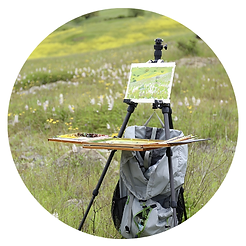
My work is rooted in the plein air tradition. Only direct observation captures what photography cannot: the felt experience of being present in a landscape, the air, the sound, the way light shifts while you watch.

I am drawn first to what is nearest. California is a state of extraordinary and endlessly varied light, and I find myself painting it again and again. Together these paintings form California Light, an ongoing series that is an ever-deepening portrait of the place I call home. The same pursuit has carried me further afield, to the alpine meadows of the Rockies, the canyons of Utah, the volcanic shores of Hawaii, and the layered, ancient beauty of Europe.

In the studio I turn the same attentive eye to still life and figurative work, seeking subjects that carry both outer beauty and inner character: an innocent child, a weathered fisherman, a face shaped by a life fully lived.

My formal training came under Boris Kokhno, retired professor from the Russian Academy of Arts in St. Petersburg, and internationally acclaimed painter Alexander Zimin, who grounded me in the Russian Impressionist tradition of bold, confident brushwork, sophisticated color, and emotional directness.

Beyond that training, I have been profoundly shaped by the Japanese woodblock master Hiroshi Yoshida (1876 - 1950), whose prints brought together Eastern and Western sensibilities in a way that feels wholly original, achieving a luminosity and atmosphere that draws the viewer completely into the scene. From his work I learned above all about composition, and how a line that is at once elegant, expressive, and precisely true to form can define the structure of any subject more completely than any amount of detail. It is worth remembering that the French Impressionists themselves were ardent admirers of Japanese woodblock prints, studying them closely for their sophisticated compositions, flattened forms, and radical simplicity, a cross-pollination that quietly shaped the course of Western painting.

Hiroshi Yoshida (1876 - 1950)
Hodakayama after the Rain
I have also learned enormously from the paintings of the British artist Edward Seago (1910 - 1974). His compositions are exquisite, his expression subtle, his colors light, and his brushwork fluid. Seago's gift was knowing precisely what to leave out, achieving through brevity what others cannot achieve through abundance.

Edward Seago (1910 - 1974)
The Orwell at Pin Mill
These influences and training have come together to form my painting style that is fresh and lively, structurally rigorous yet spontaneous. My work invites you to pause here for a moment, and step into the world as I experienced it.
WHAT OTHERS SAY
"I have looked at numerous landscape painters over the years, but few have given me the pleasure that your work has. Joyous is the word that came to mind almost immediately when I started to look at your work."
"You seem to be one of the artists who captures a spectacular quality of light in your paintings. I am quite certain that the unnameable quality of the light in a painting must be very difficult to achieve because I see it so rarely. You have a gift."
EXHIBITIONS & AFFILIATIONS
I am an artist member of the California Art Club, founded in 1909 and shaped by the early California Impressionists Edgar Payne, William Wendt, and Guy Rose, a tradition I am proud to continue. My work has been exhibited at the Oil Painters of America National Juried Exhibition, the Salon International Juried Exhibition, and the California Art Club Gold Medal Exhibition.